

Commercial battery optimisation under changing site conditions
An anonymised Queensland cold-storage site used AmpauraConnect to adapt battery operation to changing solar, load and tariff conditions.

- 7 days
- Completed operating review
- A$40.94
- Estimated additional saving vs self-consumption only
- 46%
- Lower estimated grid electricity cost
Challenge
Solar availability and refrigeration demand did not always align.
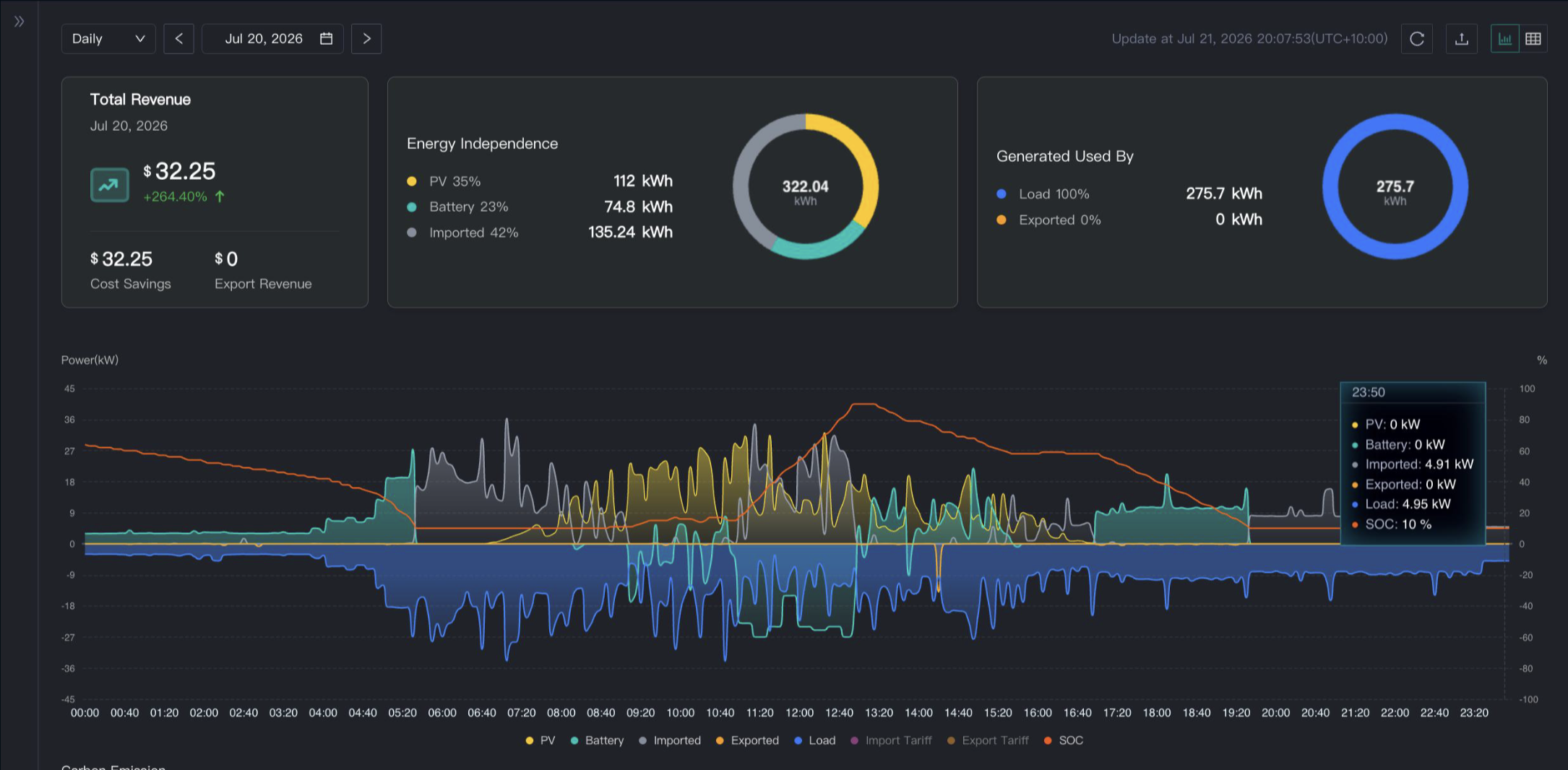
Refrigeration demand continues beyond solar hours. On some working days, solar generation was not enough to serve the site and prepare the battery for later, higher-cost demand. The objective was to use the existing battery more effectively without imposing the same charging schedule every day.
Approach
Battery operation changed with the site.
AmpauraConnect considered expected solar, load and tariff conditions before scheduling the battery. When extra charging was not justified, the site remained with normal self-consumption.
- Forecast — Consider expected solar, load and tariff conditions.
- Prepare — Charge the battery when later demand justifies it.
- Dispatch — Use stored energy when it offered greater value.
Results
A measurable improvement over self-consumption only.
Across seven completed operating days, battery timing added A$40.94 in estimated savings against a self-consumption-only comparison. Estimated grid electricity cost in the evaluated dispatch windows was 46% lower.
Estimated grid electricity cost
Same days, site load and tariff conditions; evaluated dispatch windows. Values are rounded to cents.
Outcome
Optimisation followed the site, not a fixed schedule.
Battery timing was estimated to add value when later demand justified earlier charging. When it did not, the strategy stayed with self-consumption. This site shows how AmpauraConnect adapted battery operation across seven observed days as commercial-site conditions changed.
Results are specific to this site and review period. Actual outcomes depend on load, solar generation, tariffs or market conditions, equipment and operating constraints.


